
Playing without Trae Young and Anthony Davis, the Washington Wizards were on the verge of a breakthrough.
On Friday night, the 17-55 team entered the fourth quarter against the Golden State Warriors with a two-point lead. For Alex Sarr and the youthful Wizards, it stood as an impressive showing on the road against a Steve Kerr squad with playoff aspirations.
Now the hard part, the Wizards had to close it out with their stars in street clothes. But a weird thing happened. Wizards head coach Brian Keefe never put his key starters into the game when it mattered most. Washington fumbled the lead and lost by five.
Draft your Yahoo Fantasy Baseball team for the 2026 MLB Season
It showed in plain sight one of the most bizarre developments in NBA history. In that game, one team was trying to win and the other team was trying to lose. This happens every year. What’s different this season is the sheer quantity of teams doing it and how early they started doing it. With so many of these games these days, it’s time to look at the league through an entire different prism.
Yes, the NBA prides itself on being the top competitive basketball league in the world. But if you pay close attention, you’ll notice a new phenomenon: the league has broken into two separate leagues of competition.
One league, comprising 21 teams, is competing to win. Call it the A-League.
The other league — the B-League — is nine teams competing to lose.
They’re certainly competing, just in opposite directions. And it’s warped the league in ways the league stakeholders didn’t foresee.
The latest in tanking
In February, the NBA handed out two tanking fines against the Utah Jazz and Indiana Pacers for not putting their best players on the floor. Since then, it hasn’t issued any additional punishments despite similar activity transpiring around the league.
Take the Wizards on Friday night for example. Wizards starting center Sarr had inexplicably been allowed to foul out with 5:31 left in the third quarter. Three other starters Tre Johnson, Bub Carrington and Bilal Coulibaly were pulled in the third quarter and sat on the bench the entire fourth quarter while Kristaps Porzingis, Draymond Green and Brandin Podziemski starred on the other side. If you didn’t know any better, it was as if the Wizards were told that the NBA suddenly changed the rules to say the game is decided after three quarters as opposed to four.
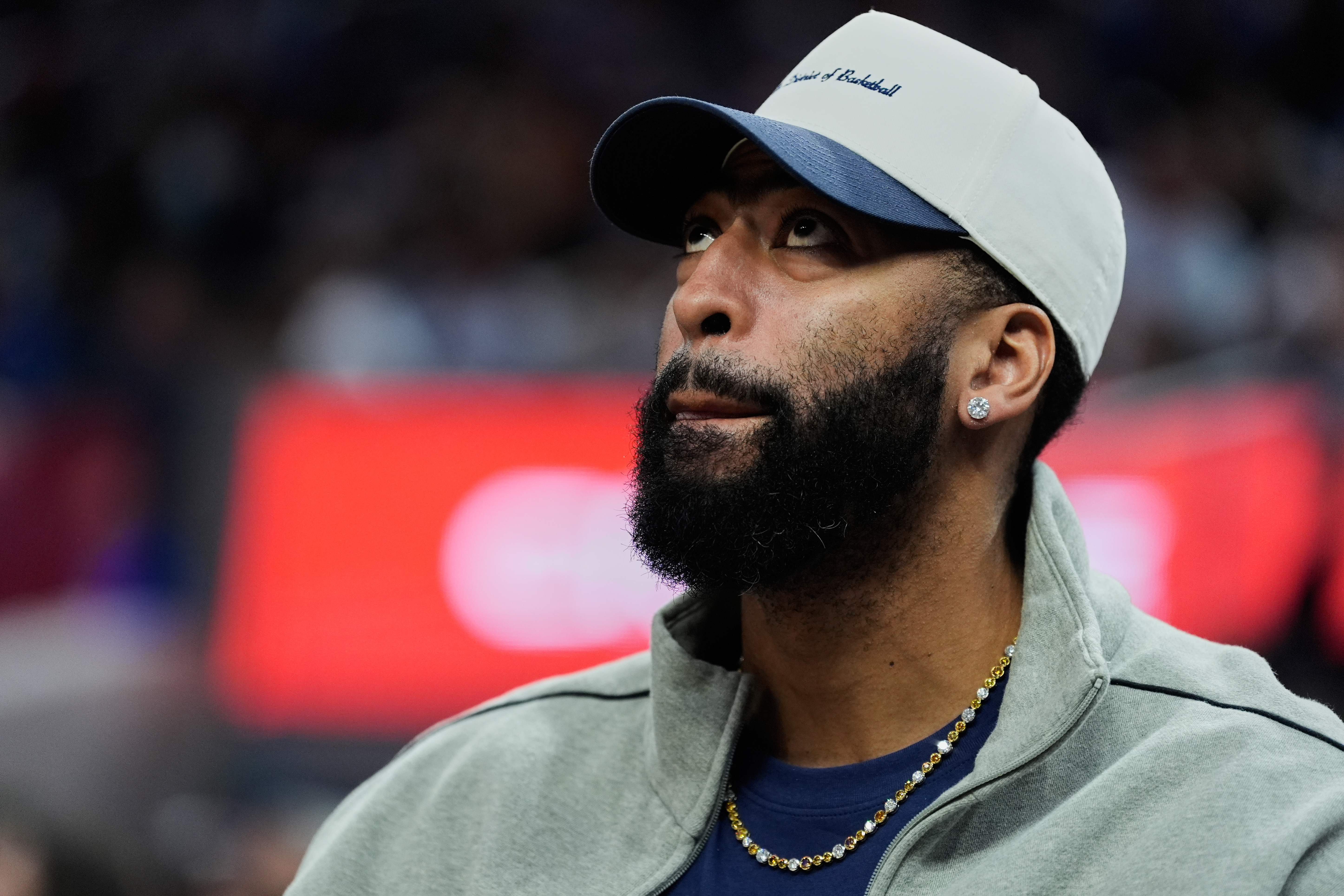
After the (four-quarter) game, Keefe stood by his dubious substitution patterns, responding to questions from Nate Duncan and Josh Robbins by saying that the players had reached their minute limits set by the medical staff. Oddly though, Keefe played Carrington for the entire first quarter and then decided he was no longer good enough – or in his explanation, healthy enough – to play at all in the fourth quarter when a win was within reach. Meanwhile, Leaky Black, playing on a two-way contract, played 42 minutes.
To those watching around the league, it was obvious what had gone down: the Wizards were tanking. By removing their best players, it seemed clear they were working to secure their 2026 first-round pick, which goes to the New York Knicks if it falls out outside the top-8. As long as the Wizards own one of the four worst records, they keep the pick. A loss, in this sense, was a win.
To date, the league has not announced any fine against the Wizards or any other teams that have violated the league’s code of conduct since the initial punishments handed out last February. Last week, the NBPA issued a statement urging the NBA to take action against the Milwaukee Bucks for holding out star Giannis Antetokounmpo and said the “integrity of the game” was at stake. As of this writing, the Bucks have not been penalized for their handling of their global superstar.
As of now, nine teams are responding in kind to the draft lottery structure that incentivizes losing games and the expanded race to the bottom has distorted everything. A look at the standings reveals a stratified league unlike ever before. In the East, the No. 10 seeded Charlotte Hornets have a 9.5-game lead on the No. 11 seeded Milwaukee Bucks. In the West, the No. 10 seeded Warriors have an 11-game lead on the No. 11 seeded Memphis Grizzlies.
A perfect storm of draft lottery incentives, the play-in tournament, a loaded draft class and increasing star absences has created a phenomenon of other sorts: a pseudo minor league within the NBA ranks.
The B-League vs. The A-League
The chasm between leagues is obvious once you track the results. The only teams the Wizards have beaten since the All-Star break are the Indiana Pacers (twice) and the Utah Jazz – two members of the B-League, which means that for almost two months straight Washington has yet to beat a team that is not actively trying to lose.
For the Wizards, Friday’s loss to the Warriors, Sunday’s defeat at the hands of the Portland Trail Blazers and Monday’s blowout loss to the Los Angeles Lakers extended their A-League losing streak to TWENTY straight games. That’s right: the Wizards have gone 0-20 against teams trying to win, having dropped every game against an A-League opponent since Detroit lost to the ‘Zards in early February.
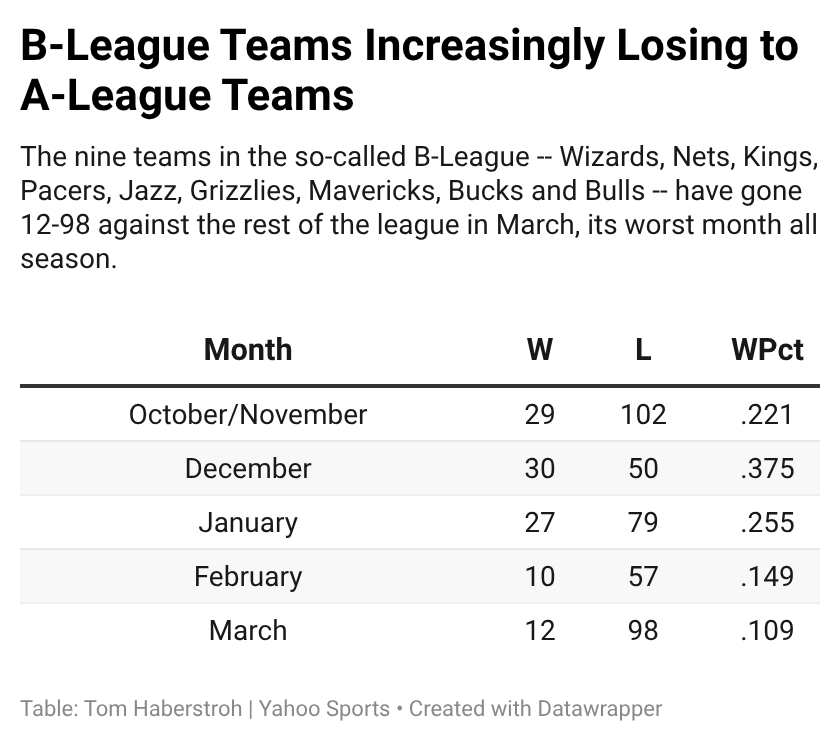
Here’s a summary look at the B-League teams in recent “competition’ against A-League teams:
-
Washington is 0-20 in its last 20
-
Brooklyn is 1-29 in its last 30
-
Sacramento is 1-23 in its last 24
-
Indiana is 2-12 in its last 14
-
Utah is 1-14 in its last 15
-
Memphis is 1-17 in its last 18
-
Dallas is 2-23 in its last 25
-
Milwaukee is 1-12 in its last 13
-
Chicago is 3-17 in its last 20
Aggregate those utterly sad win-loss figures and you’ll find B-League teams have posted a dastardly 12-167 record against A-League teams across those varying chunks of games. Twelve wins and 167 losses. That’s almost 15 losses for every win.
The outright futility is so pervasive that it’s worth wondering if more than a third of the league has essentially split off and morphed into a G League division. Seriously, if the South Bay Lakers, who went 26-10 in the G League this season, played 179 games against A-League competition, could they eke out 12 wins over that span? It’s not out of the realm of possibility, and that’s what’s so unnerving about the state of the league.
If you feel the above breakdown is misleading, the monthly breakdown paints the same alarming picture. In the month of March, B-League teams have been walloped by A-League teams to the tune of a 12-98 record, which equates to a .109 record – the worst month this season. Since December, the B-League teams have fared increasingly worse as the draft lottery nears.
One thing to make clear: the New Orleans Pelicans, who have a 25-51 record, would be slotted in the A-League in my book because their lack of a first-round pick means they don’t have an incentive to lose. With Dejounte Murray back and interim head coach James Borrego leading the team, the Pels are a .500 team over their last 30 overall games. (Meanwhile, the Mavericks, who own their 2026 first-rounder, are 5-25.)
The fact that bad teams are losing to good teams isn’t the story here. It’s how many of them threw in the towel so early in the season. Half the season has essentially become an exhibition of playoff teams against G League rosters. And it’s only getting worse. The question is whether this is a one-year blip or a sign of things to come.
Is this the new normal?
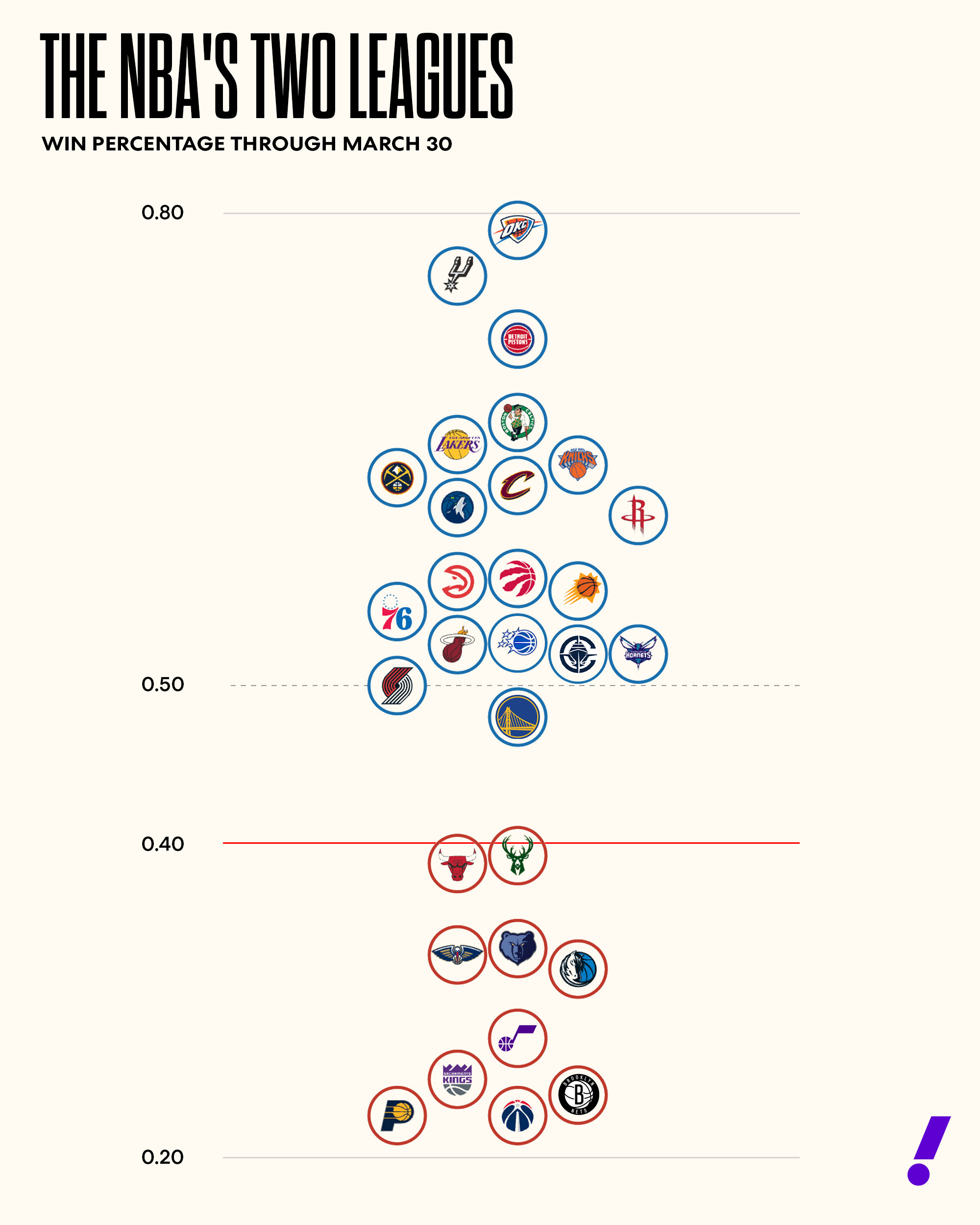
A standard read of the standings plays a trick on our brains. With the No. 11 seed shown just underneath the No. 10 seed, it’s hard to fathom how far apart those teams are. A visual representation of team standings tells the story. Then you can see an ocean between the two masses of win percentages.
We can show this in a couple ways. One, a visual representation of the standings illustrates how clustered the two groups of teams are in reality. A standings table simply doesn’t do the stratification justice.
Another way to put this in perspective is looking at the postseason gap history. The East postseason gap is 9.5 games while the West postseason gap is 11 games, which means the moat between postseason teams and non-postseason teams is a combined 20.5 games. That’s nearly twice as big as the previous largest gap this century (11 games in 2018-19). In fact, this year marks by far the largest cushion since the NBA went to the 16-team playoff format in 1984.
Interestingly, the advent of the play-in tournament seems to have broadened the gap. Excluding shortened seasons in 2020-21, 2019-20 and 2011-12, recent seasons have exhibited a much more pronounced separation.
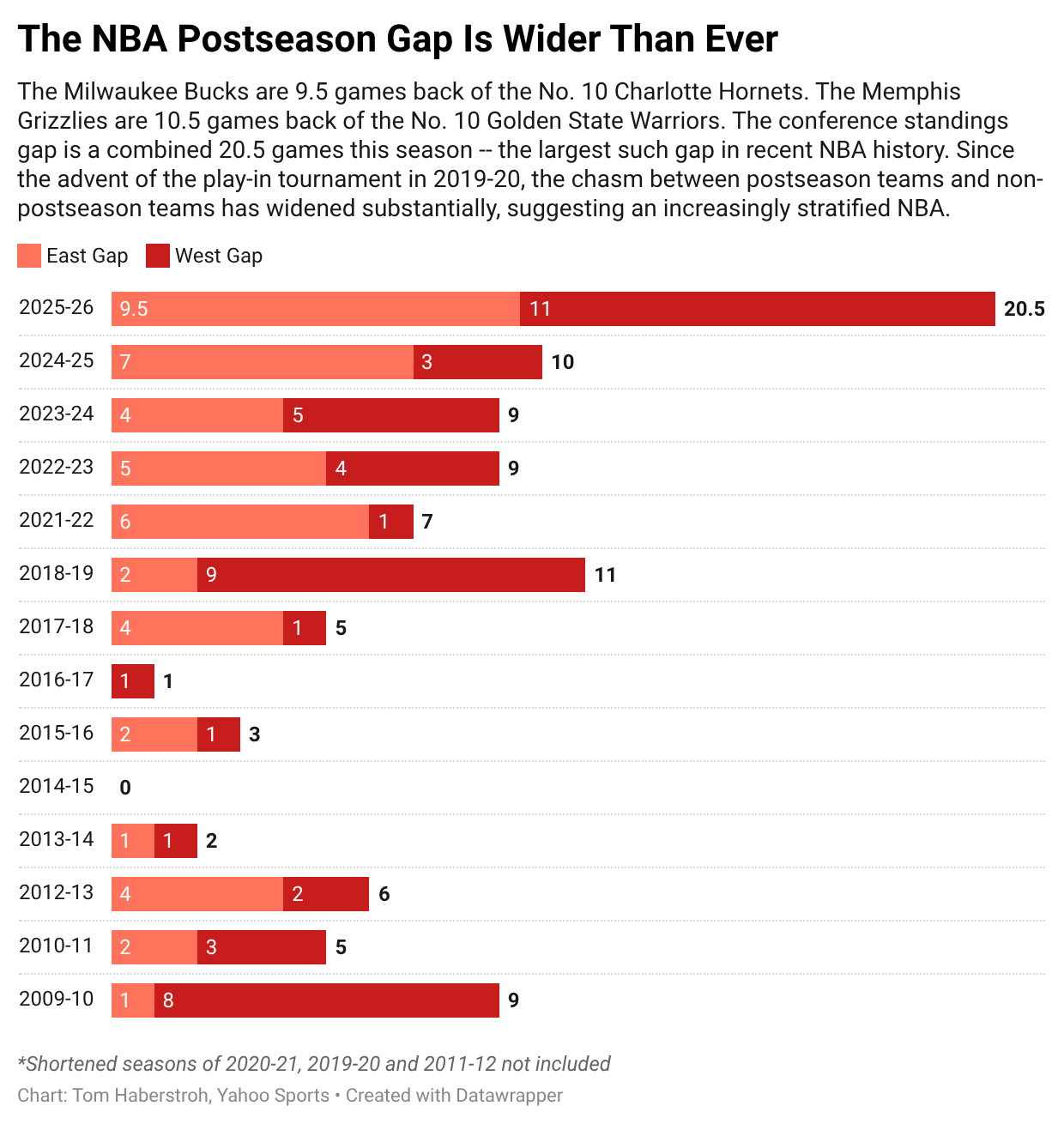
In the first 82-game season after the pandemic, the gap between No. 10 and No. 11 was a collective seven games. Since then, it has jumped to nine games in 2022-23, nine games again in 2023-24 and 10 games in 2024-25 before exploding to 20 games this season. In the post-play-in-tournament world, we have seen an average gap of 11 games of separation. In the previous 10 seasons, with no play-in tournament, that same figure was just 4.8. To put it simply, the play-in era could also be known as the play-out era.
This is not to suggest that the play-in tournament has been a total miss (I’m still a fan). But it also hasn’t been perfect. The play-in tournament was supposed to be an anti-tanking sledgehammer, but it seems it only axed the league into two parts: the Haves and Have-Nots. Those who think this is a one-year stratification blip should consider that the gap has doubled in size in recent years.
So what happens now?
It’s hard to pinpoint exactly one main cause of this recent phenomenon of the A/B League stratification. One possible catalyst is the fact that every NBA owner and front office saw the Dallas Mavericks jump all the way from No. 11 to No. 1 in the draft lottery to land Cooper Flagg last season. The previous season, the Hawks soared to No. 1 from No. 10.
While it’s true that the draft lottery odds haven’t changed in recent seasons, there’s that whole cognitive bias about “seeing is believing.” Teams in the back of the lottery always knew the odds were stacked against them, but when lightning is caught in a bottle not once, but twice? That might change behavior in some front offices.
Add that recency bias to the fact that this is a loaded draft class featuring AJ Dybantsa, Darryn Peterson, Cam Boozer, Caleb Wilson and Darius Acuff Jr., and it’s totally possible that front offices are responding to a cost/benefit analysis that points toward ping-pong balls, not the play-in. As we get deeper into the play-in era, a spot in the play-in tournament may not be as appealing as initially designed.
For those on the outside of the play-in tournament picture, chasing the No. 10 seed isn’t all that thrilling when you look at the less-than-exemplary results. Among the No. 10 seeds in the play-in era, only one out of 10 teams has successfully punched a ticket into the playoffs. That team, the 2024-25 Miami Heat, tells a story that won’t inspire many future No. 11 seeders.
Last year, the No. 10 Heat were beaten to a pulp by the top-seeded Cleveland Cavaliers, getting swept 4-0 in one of the most lopsided series in NBA history. The final scores in Game 3 and Game 4? 124-87 and 138-83. Congratulations No. 10 seed, you made the playoffs – now get pantsed in front of the national audience!
The latest anti-tanking proposals reported by ESPN’s Shams Charania probably won’t address the B-League stratification problem. If anything, one of the proposals might only exacerbate the race to the bottom 10 teams.
The first proposal, ESPN reported, envisioned a system in which 18 teams would all be part of the draft lottery. The bottom 10 teams would have an equal 8% chance of moving up in the lottery, with the other 20% of odds being shared among the eight play-in teams. It doesn’t take a rocket scientist to see how that would further incentivize the bottom 10 teams to stay there by losing a gazillion games and maximizing its odds to land the No. 1 overall pick.
The other two proposals also expand the draft lottery to playoff teams, and work in different ways to attempt to thwart tanking, but each of them could present new unintended consequences, such as tanking out of the first round in order to land a shot at the No. 1 pick. Any team going down 2-0 in the first round would have a giant carrot to blow the next two games and throw its hat in the draft sweepstakes.
The solutions aren’t going to be easy. From where I sit, the league should do away with the draft entirely and go from scratch with a rookie free agency. Shortening the schedule as I proposed would also curtail extended tankjobs. The dizzying anti-tanking proposals above may seem sophisticated and comprehensive, but it’s unclear how the models will correct the NBA’s A-League and B-League phenomenon. If you think too many teams are trying to lose now, just remember, the list could expand soon. The NBA could even add two more teams to the B-League party.